

CHRIS ARRIVES TO COMMENCE HIS STUDY TOUR
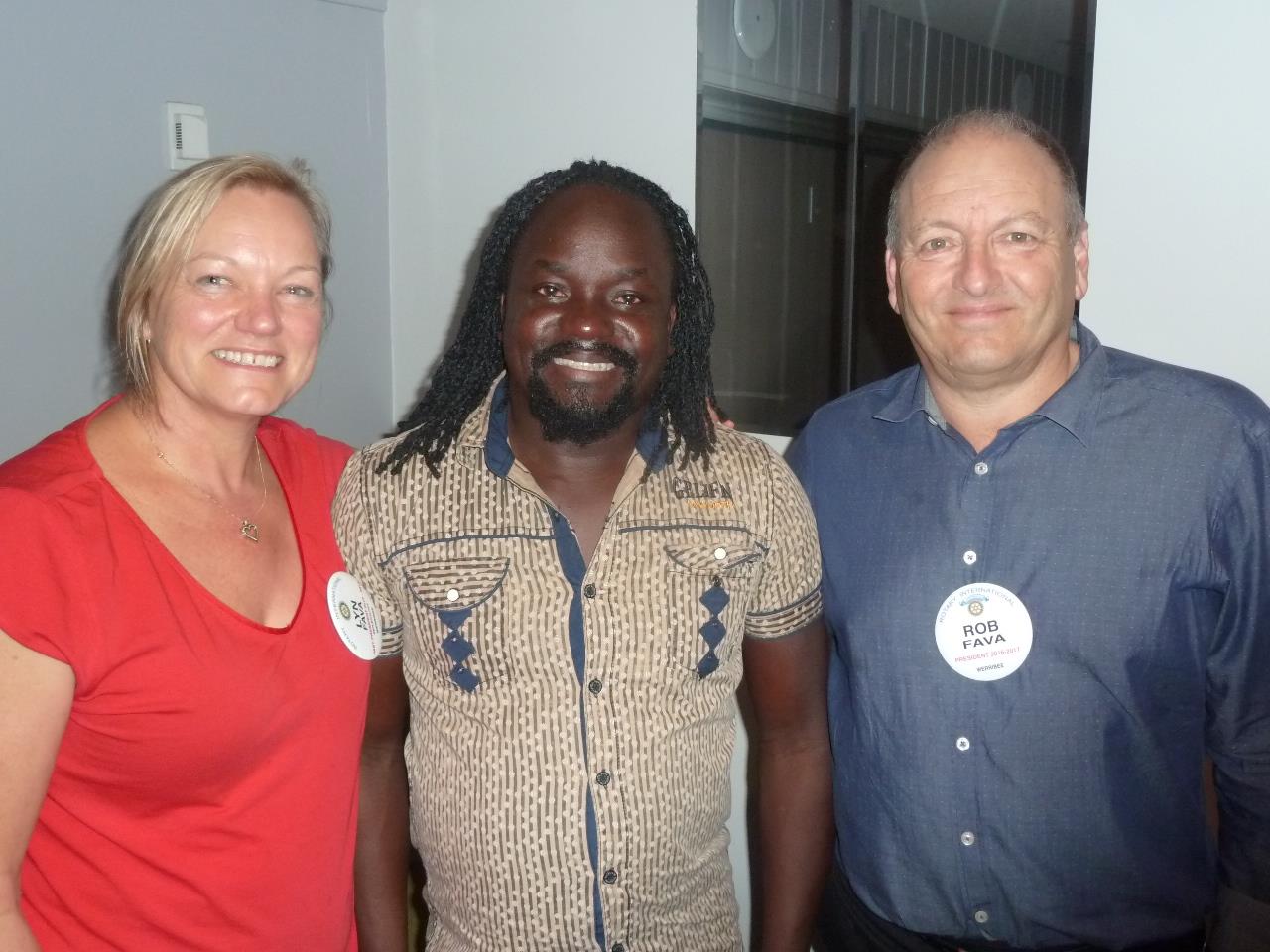
Chris Ochaya has arrived in Melbourne from Uganda to commence his agricultural study tour as part of the Royce and Jean Abbey Scholarship Award.
Chris attended our Rotary meeting and, in the absence of our scheduled speaker, he gave an impromptu talk about himself and the challenges that his country faces. He started by expressing his gratitude for the efforts of the club and specific individuals to enable him to obtain the scholarship.
He is also thankful for the contribution that we made towards the construction of a new bore water system in his home town of Gulu. He said the water is flowing well and has made such a big difference to the local school and the community. He said that the system is even generating savings of $800 per month because it is gravity fed and, hence, does not use as much power.
Here are some of the highlights of Chris' talk:
- Uganda has a population of 31 million people.
- The country was torn apart during the reign of Idi Amin in 1971-79.
- During that time, there were 500 international and local NGO's (Non-Government Organisations) that were supporting the people through food and clothing handouts, etc.
- After the war, the NGO's disappeared which left the people without any support. They didn't know how to sustain themselves. This problem has existed for many years now and the government has been unwilling or unable to help.
- After finishing his studies at university, Chris moved to northern Uganda to take up a teaching role in history and religious studies. He teaches in the community, not at the school. He speaks 5 local languages fluently.
- In his spare time, he has set up a community farm. It is a small farm that is used to teach the locals how to produce food that will support their families. The farm grows various varieties of fruit (e.g. bananas, papaws, pineapples) and also crops including maize, beans, ground nuts, cassava and rice.
- Family sizes can be 8 or more and the fathers have no idea how to support them. So they are invited to the farm to learn how to grow, harvest and store products for future consumption or for selling.
- Chris and his band of volunteers, which includes retirees and agricultural experts, teach up to 12 people at a time to learn the basics of sustainable farming.
- He is very excited about his trip to Australia because he wants to learn about our techniques so that he can adopt them in his environment.
Chris is here for 3 months. He will visit and stay at a variety of farms. We will hear from him again towards the end of his tour.
Everyone found Chris to be a very easy-going and personable character. And his stories are very interesting. If you would like to invite him home for a meal or take him on a day-trip, please contact Brian Ahmed as soon as possible. His social calendar is starting to fill quite quickly.